








TRANSACTION
MONITORING
High-performance detection.
AI at the core.
Start with an extensive AML typology library, informed by financial crime expertise and regulatory engagement, then test and tune detection safely using a no-code rules builder and sandbox, all on real data before anything goes live.


Is your monitoring system catching financial crime, or just keeping up with volume?
Transaction volumes keep growing, and so does the data behind them, but legacy monitoring forces a choice between coverage and cost. Static, rule-only detection misses behaviour that shifts faster than rules can be rewritten, so alerts pile up while real risk slips through. When a regulator asks for evidence, teams are left piecing together the story from disconnected systems instead of pulling up a clear answer.
Napier AI Transaction Monitoring closes that gap. Rules and AI work together across every investigation, so detection keeps pace with how financial crime actually moves, and every decision comes with the evidence to back it up.


Features

No-code rules builder

AML typology library

Guided case management

Explainable rules and AI detection

Sandbox testing and deployment

AI strengthens your detection

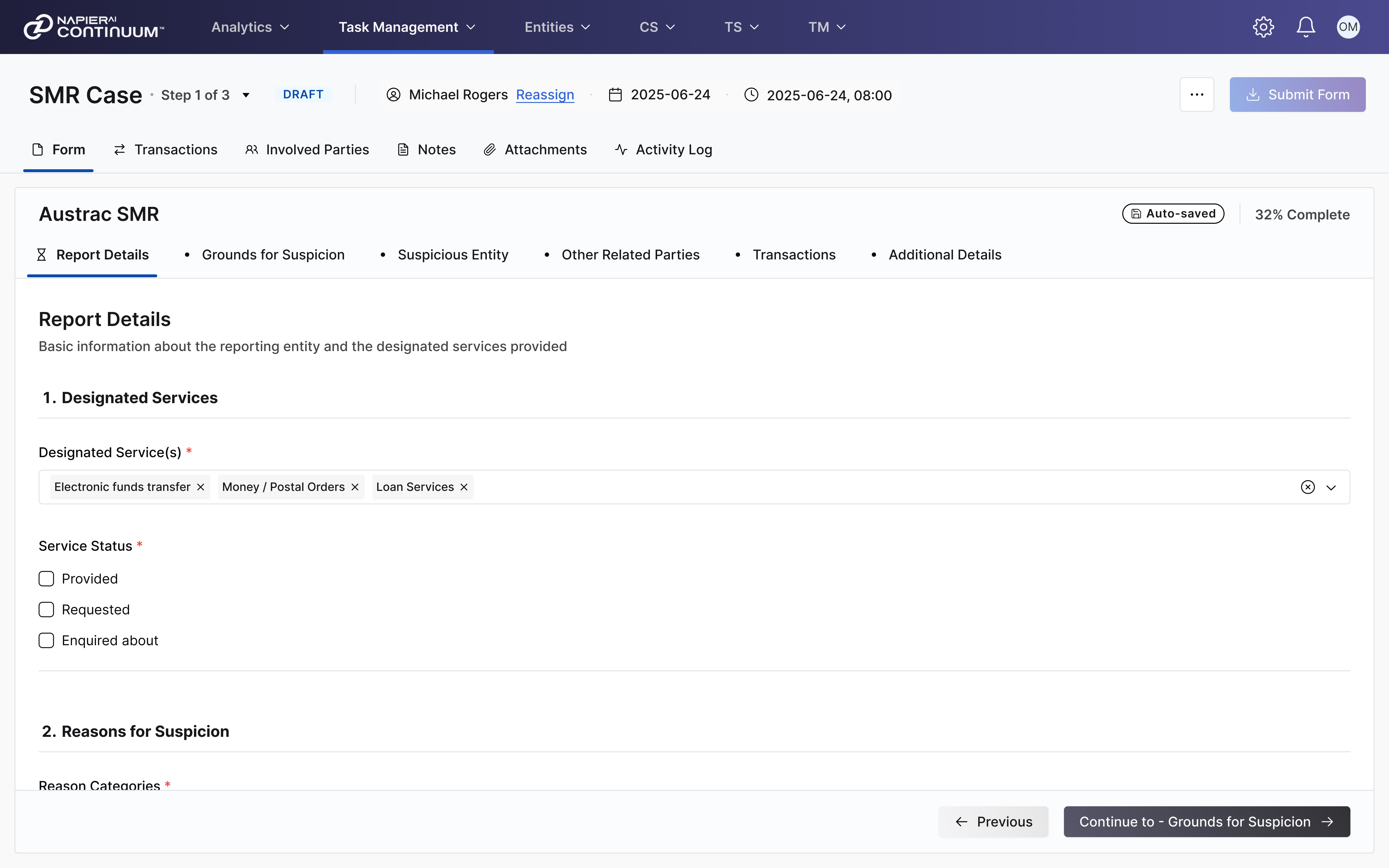
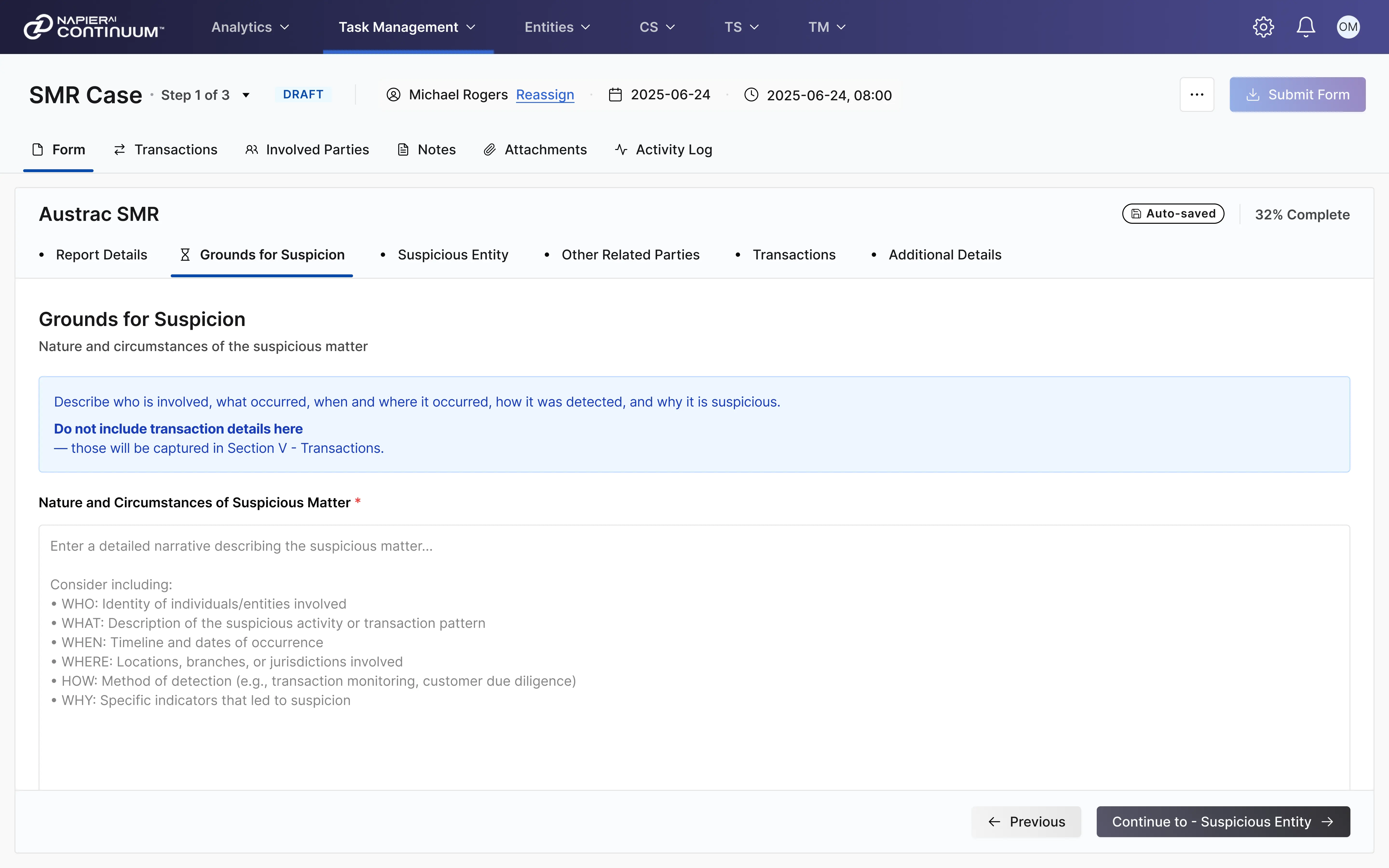
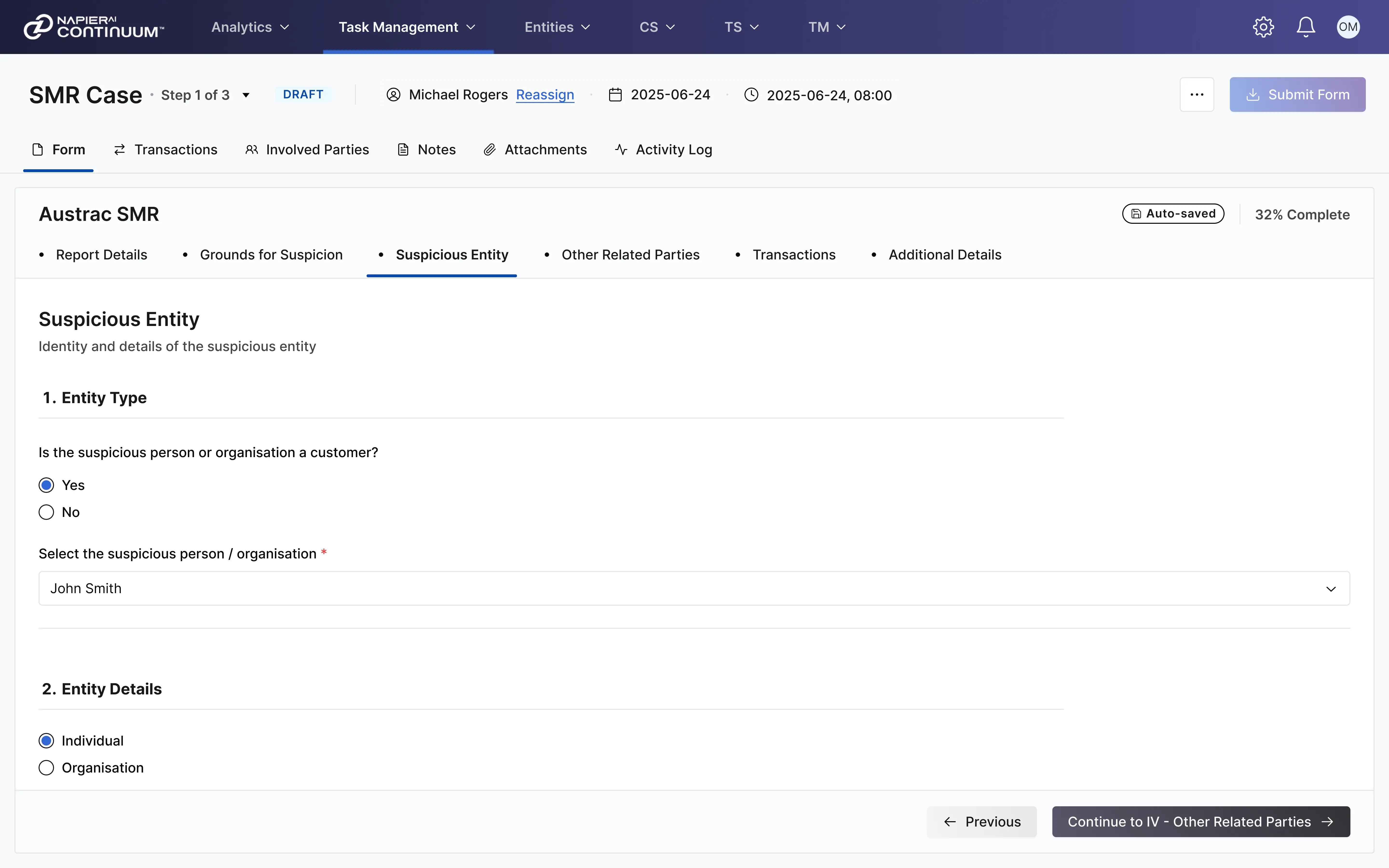
Designed to be used with Napier AI’s Transaction Monitoring and Screening solutions, the Regulatory Reporting Manager helps compliance teams move from investigation to regulatory submission in one workflow.
By using investigation context to auto-populate report fields and combining structured workflows with built-in validation, it reduces manual effort, improves consistency, and supports timely, compliant filing.
Benefits

Improved risk management
Governed rules and AI work together to tune detection to each customer's risk level, keeping it calibrated to the organisation's own risk appetite as it evolves.

Zero impact on day-to-day operations
Test changes against real production behaviour in the sandbox, then promote only when the numbers hold, with zero impact on live operations.

Reduced false positives
Build, test and deploy detection changes safely, calibrating rules in response to shifting criminal behaviour and regulation to cut unnecessary alert volumes.

Explainable AI improves decision-making
AI where it adds value gives plain-language explanations of what is driving an alert, so teams can escalate or discount with confidence, not guesswork.

Fewer false negatives, stronger alerts
AI where it adds value surfaces unusual patterns that would not typically trigger a rule, helping teams catch behaviour rules alone would miss.

Increased operational efficiency
No-code rules andsandbox testing, guided case workflows, and explainable AI combine to cut manual effort across the investigation lifecycle.

Reduced costs
Flexible deployment, a scalable architecture and the efficiency gains above all bring down total cost of ownership.
Results with real impact

See what our clients have to say
"Ensuring the highest standards of financial compliance is paramount in our mission to create a fair financial world for businesses globally. Partnering with Napier AI reinforces our commitment to the security and integrity of our platform, ultimately benefiting the ambitious businesses we serve."
Angela Knight
Head of Risk and Compliance, 3S Money


Details
Define & build rules
Start from an extensive AML typology library, developed in collaboration with regulators, then author rules in plain language using the newly rebuilt rules builder, no coding required.
Preview the impact of a change before it goes live, and manage change at scale with a full audit trail across every user and system action, and version history maintained automatically as rule estates grow.


Manage cases and workflow
Manage cases through asingle, self-auditing platform that defines and unifies every step of aninvestigation, with a full audit trail carried through automatically.
A highly configurable dashboard, built from a palette of over 80 widgets, showsonly the data relevant to a defined workflow, so each user sees what matters totheir task and nothing else.
Enhance your analysis
Rules and AI work side by side, not as separate systems. Each generates its own score, so teams can compare rule-based and AI-driven views of risk and prioritise the daily workload accordingly.
Drawing on transaction history, watchlists and past customer behaviour, AI where it adds value complements rules-based review, surfacing patterns that are difficult to spot across high volumes of data.


Simulate, test and deploy
Build and test rules and scenarios in the sandbox, using real production behaviour or your own datasets, before anything goes live.
As new intelligence on suspicious behaviour emerges, scenarios can be tested and refined repeatedly, so detection keeps pace with changing financial crimeand regulatory requirements without disrupting live operations.
AI strengthens your detection
AI where it adds value is embedded directly within transaction monitoring to support investigations as they happen, surfacing behavioural patterns and potential new or emerging risk within the task itself, so analysts understand the context behind an alertwhile investigating, not after.
Clear, AI-driven explanations of customer behaviour reduce manual analysis and context switching, guiding analysts toward the most relevant signals at the point of decision.
AI agents also challenge detection configurations against evolving laundering scenarios,helping identify gaps and suggest ways to improve rules and strategies, all while keeping human judgement in control.

Downloads

Blog


Our Solutions


Transaction Monitoring


Transaction Screening


- Get access to bi-monthly newsletters with insightful reads and curated regulatory news
- Be the first to receive our latest whitepapers, eBooks and podcasts
- Get invited to exclusive events, featuring AML compliance experts from across the industry
