.svg)










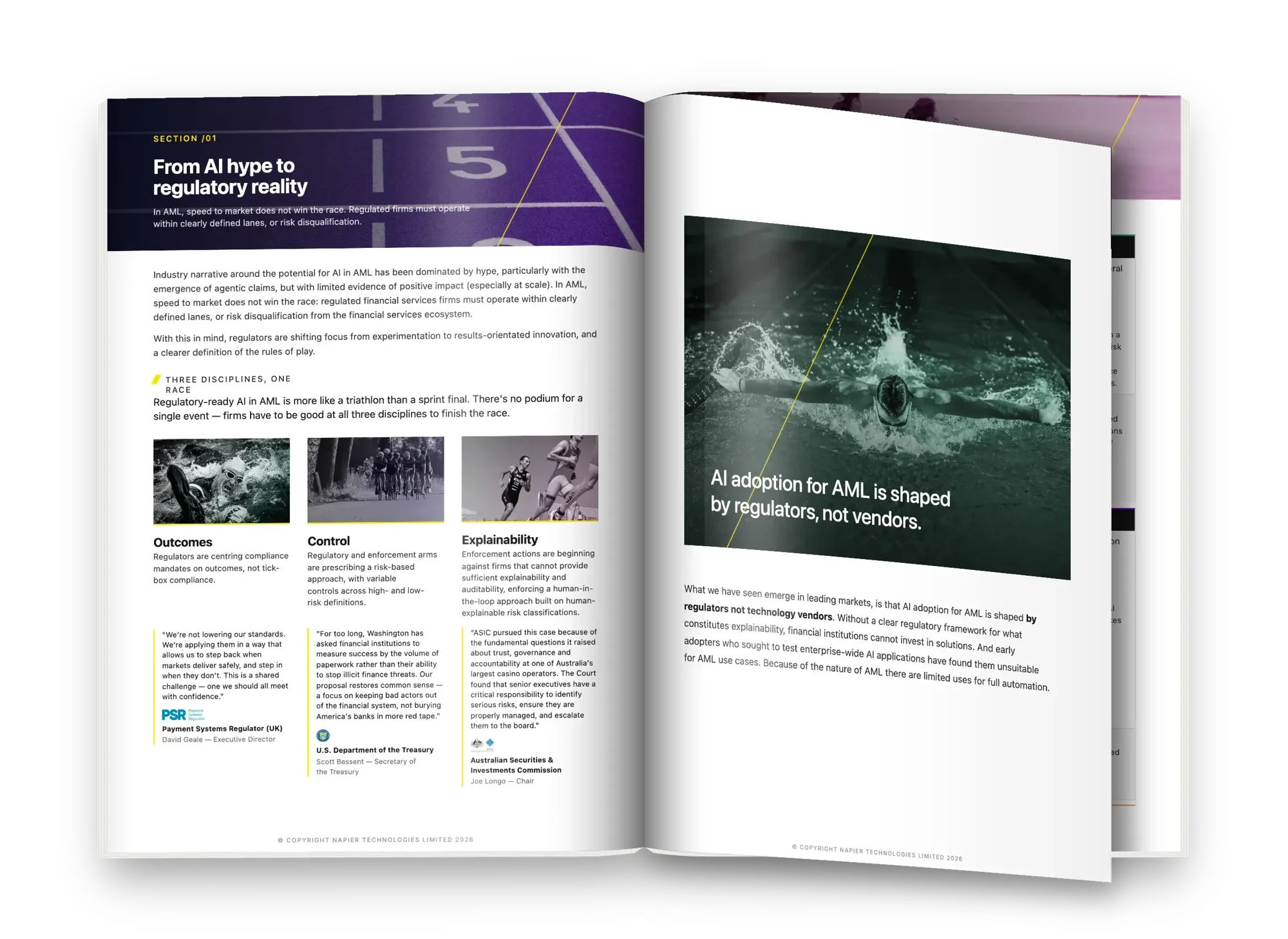
Artificial intelligence (AI) in anti-money laundering (AML) has reached a turning point. The conversation among regulators, banks, and vendors no longer centres on whether AI belongs in financial crime compliance. The ecosystem is now focused on identifying which jurisdiction gets the rules right first, and what that means for everyone else. That question matters more than it might seem, because whoever sets the first credible frameworks for acceptably explainable AI in AML, effectively writes the playbook for the rest of the world to fast-follow.
AI adoption in financial crime has moved from cautious pilots to boardroommandates, but in my experience the leading markets will be those with theregulatory maturity to make AI accountable.
Three regulatory mindsets, not one global standard
Rather than a single global timeline, what's emerging looks more like three distinct postures.
1. AI accelerators
United Kingdom (UK) and France
Already has the sandboxes, risk-based supervision and public-private collaboration to let AI-driven transaction monitoring and entity-centric risk scoring mature safely.
2. AI appreciators
United States of America (USA), the European Union (EU), and Singapore
Close behind: enthusiastic but working through fragmented rulebooks or AI legislation that wasn't written with AML specifically in mind.
3. AI appraisers
Australia, Canada, and United Arab Emirates (UAE)
More cautious by instinct, prioritising auditability and explainability over speed, which paradoxically may end up setting the toughest global bar for what AI inAML must prove before it's trusted.
What ties these groups together is more interesting than what separates them: none of them are mandating AI outright. Instead, regulators are converging on outcomes explainability, auditability, human oversight and leaving the technology choice to the institution. The EU AI Act comes closest to a binding framework, treating transaction monitoring, KYC and sanctions screening as "high-risk" AI use when AI is used, without requiring that it be used. FinCEN in the USA is taking a softer (but no less real) approach, signalling that AI adoption can positively influence supervisory outcomes. Even AUSTRAC in Australia, with no AI-specific law at all, is making AI necessary in practice simply by demanding detection standards that legacy, rules-only systems cannot meet anymore.
The use cases regulators will trust first
Regulators aren't approving "AI" as a category, but instead we see them approving specific, well-evidenced use cases. Transaction monitoring optimisation, alert prioritisation, KYC and customer risk scoring, and Suspicious Activity Report (SAR) drafting support are all gaining traction as first-wave use cases precisely because they're explainable and auditable.
In the more mid-term view, network and entity analytics, cross-institution intelligence sharing and continuous KYC are following as second-wave advanced use cases: powerful, but harder to evidence today.
Then there's a smaller set of high-scrutiny applications (even if they seem technically simple), like fully autonomous decisioning for supposedly low-risk transactions, where the industry needs to be honest that determining what counts as "low risk" is itself a bias-sensitive judgement call regulators aren't ready to delegate outside of human-in-the-loop requirements.
Why agentic AI alone won't satisfy regulators
Workflow orchestration is not the same as risk reduction. An agent that triages alerts faster, without improving the underlying detection quality, doesn't reduce financial crime risk it just moves the same risk around more efficiently, while adding a new layer that itself needs to be explainable, auditable, and free of hallucination or omission. As transaction volumes keep growing, that's a short-term fix that gets more expensive and less defensible over time.
The model regulators will trust is different: AI built around embedded, jurisdiction-specific risk intelligence, informed by shared typology knowledge across institutions, and subject to continuous validation as new patterns emerge. That's a harder thing to build than a workflow layer, but it's the AI in AML that survives sustained regulatory scrutiny rather than a single audit cycle.
What this means for financial institutions now
Regardless of where an institution operates, the direction of travel is the same: AI in AML is moving from experimentation to regulatory endorsement, to (eventually) expectation. Institutions in first-mover markets should be piloting explainable AI use cases now and helping shape what good looks like.
Those in fast-follower markets have an opening to import proven, tested approaches rather than reinventing them.
And institutions in markets yet-to-mandate shouldn't mistake regulatory caution for time to wait they should take advantage of this window get the fundamentals of explainability, auditability, and governance right before the bar rises.
The institutions that win this next phase won't be the ones with the most complex models. They will be the ones whose AI is built to align with how regulators wherever they sit on this spectrum define acceptable, explainable, artificial intelligence. That's a compliance-first design principle, not a technology one, and it's why getting the foundations right matters more than moving fastest.
Read the full white paper, "The Race to Regulate AI in AML: Which Nations Are First Out the Blocks and What It Means for Financial Institutions," for a detailed jurisdiction-by-jurisdiction breakdown.