


.svg)










Global financial crime compliance approaches have evolved rapidly, with significant strides forward even in just the last year. Particularly of note, are the regulators who have brought their markets out of the experiment phase, and into tangible AI innovations across a range of use cases.
Many governments have begun launching their own national AI programmes, and regulators are embedding explainability into supervision, with both Germany and France providing express guidance for Large Language Models in Europe.
AI for AML Use Cases:
Gen AI: Natural language interpretation and creation, Synthetic data creation
Agentic AI: Agent-based testing
CoPilots: Human-in-the-loop regulatory requirements
The AI Trust Test
Despite the potential for AI in AML and some regulatory endorsement, many financial institutions are stuck at pilot stage when it comes their own implementations. Explainability and governance are the critical trust test for AI in AML.
“The advent of AI is probably the most important trend going forward. It’s a positive because a lot of times the data load in AML processes is significant and AI allows a clearer picture of data outputs. A negative trend is AI being used by criminals to commit fraud that will see the need to fight AI with AI.”
Respondent to the napier ai / aml index
Which markets pass the AI Trust Test for AML?
The Napier AI / AML Index 2025-2026 uncovered markets exhibiting strong confidence in AI for AML including, the United Kingdom and the United States, with France not far behind.
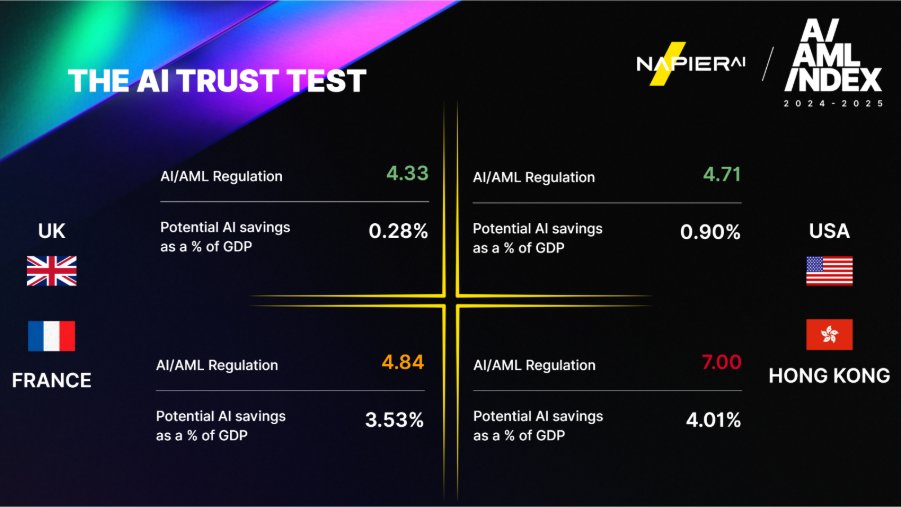
The AI / AML Regulation score in the Index quantified attitudes to AI usage and the role of regulators in the region, specifically whether the financial crime prevention leaders felt that regulation was a help or a hindrance in improving AML outcomes, and its impact on the total cost of compliance. This, combined with the projected reduction in financial crime losses as a result of AI for AML is a good indicator as to how effective regulation has been for the region.
Ahead of the curve
United Kingdom: The UK has embraced AI experimentation with high trust, through close collaboration from the regulators, such as the FCA's Supercharged Sandbox. There are some significant savings yet to be realised following heavy investment, and banks still need some support to fully dive in. Because of the strong underlying AML frameworks, relatively effective financial crime compliance, and high rate of adoption of AI, the UK has less remaining benefit to extract from AI than a lot of its large-economy European counterparts.
United States: The US is a global leader in AI, and due to the high value of money laundered through its financial ecosystem, there are a lot of savings to be made in absolute terms. Although it may currently lose a relatively small percentage of its total GDP to money laundering, financial crime is a growing concern. Its leading AI/AML regulation score confirms a strong trust in AI, but there is still some room for improvement in terms of realising the benefits.
Plenty of Potential
France: France has a robust AML regime, strong technical base, and structured big data platforms in financial services, but with regulatory conservatism and supervisory caution, AI adoption has been slower. France has a lot of large institutions which need to comply with stringent employment laws and continue to spend on compliance FTEs as a result. A large gap remains to be bridged in terms of AI trust before it can capitalise on AI for AML.
Hong Kong: Hong Kong is a global financial hub with deep AML expertise, but there is a hesitancy to heavily invest in AI due to the high upfront cost. Financial institutions often run pilots but have not yet pushed to scale. Its strongly improved performance in AML Attitude score is undermined by poor scores across AML Effectiveness, AI/AML Regulation and TCO, putting it at the bottom of this Napier AI / AML Index 2025-2026. But with recently issued optimisation guidance for transaction monitoring and generative AI data governance standards, Hong Kong’s regulator appears to be investing in all the right initiatives to overhaul its AML challenges. And with potential AI Savings of $1.53bn, the payoff could be massive.


